Talks and other stages I was on
Designing for Chaos: UX for dirty hands, ladders, and blaring alarms
Enterprise UX Conference 2026 Act Eventstudios Arnhem – November 6, 2026You can’t design what you’ve never seen up close.
Enterprise software assumes a quiet desk, but frontline professionals work on ladders, in dim corridors and next to blaring alarms. Through three of them – a fire safety technician, a travel agent and a care worker – this talk shows what physical, informational and mental chaos does to the way someone uses an interface. It introduces three principles for designing in that chaos (operational robustness, actionable clarity and systematic trust) and shows how measuring one inspection round turns a workaround into a number a boardroom cannot ignore.
The role of digital design in empowering professionals in mobility operations
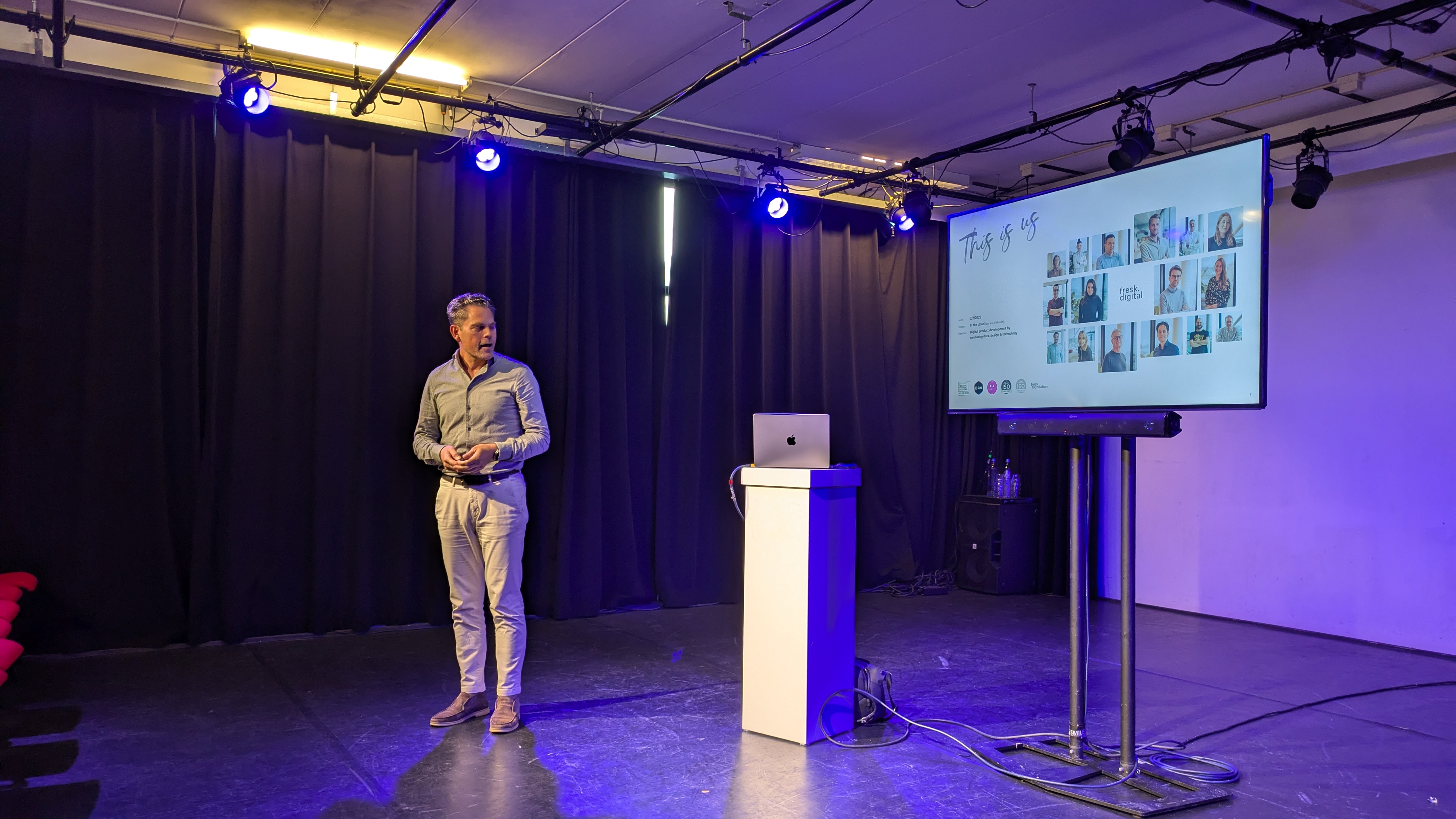 Emerce EDAY Mobility Connect De Kromhouthal Amsterdam – October 3, 2024
A great experience starts backstage.
Like a concert, a digital experience depends on what happens behind the scenes. When backstage processes are inefficient, engagement drops, solutions become error-prone, teams lose alignment, interfaces get complex and strategy fails. Building on fresk.digital’s shared mobility research, this talk follows a shared bike or moped rider from finding a vehicle to ending the ride, and then shadows the people who keep the fleet available. A service blueprint brings both views together, layer by layer: rider and employee behaviour, touchpoints, backstage and support processes, and data. It feeds the interface design, connects technical processes to interfaces, shows what the architecture has to support, and when and how to measure. A second case shows the same approach in practice: for Rocsys, maker of charging robots for unmanned yard trucks, understanding the context, workflow and business goals turned a spreadsheet into a robust, secure and scalable fleet tool for program managers, maintenance and service engineers.
A wall becomes a bridge
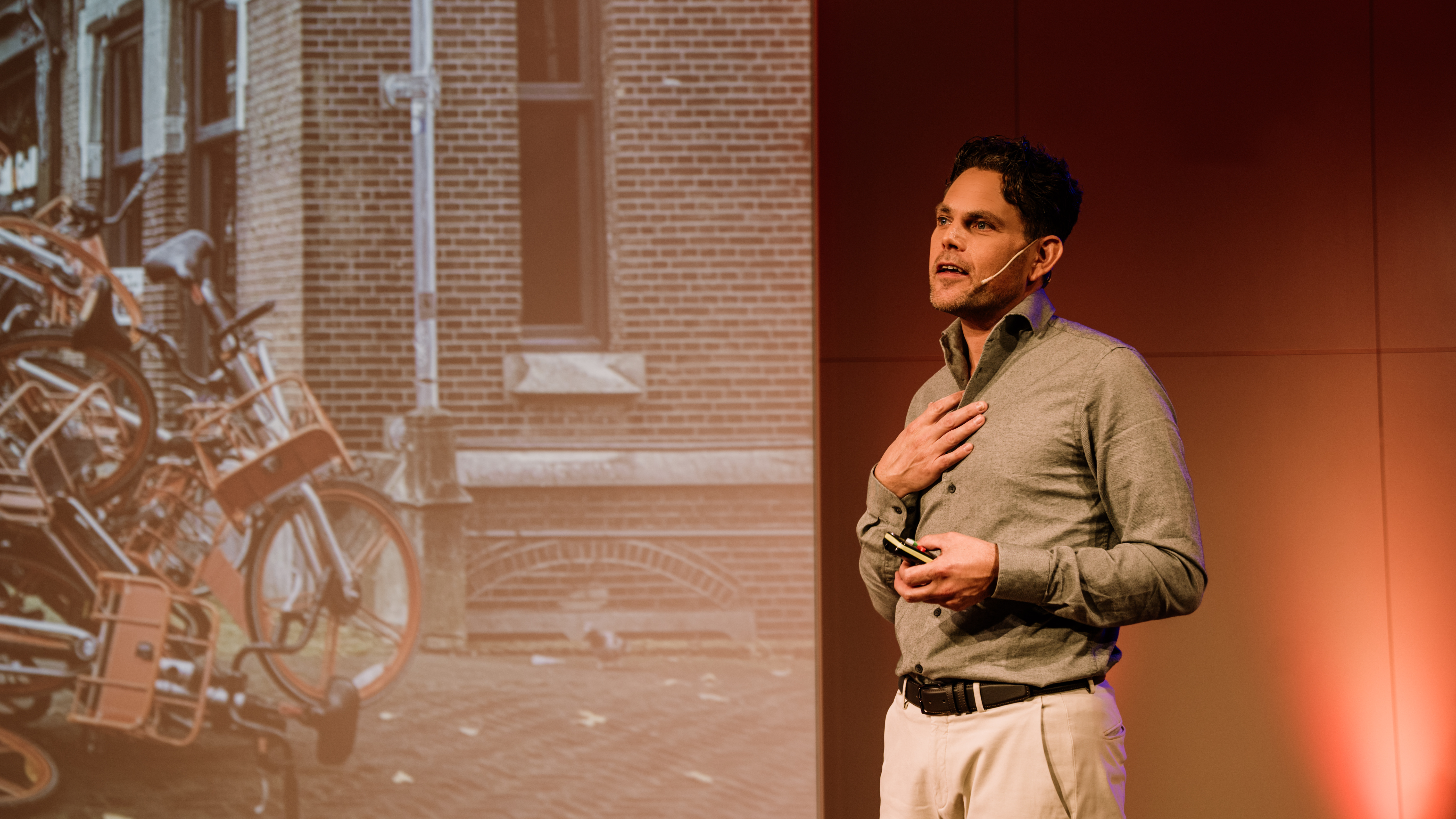 Design the Next Step 2022: Breaking Barriers Rijksmuseum Amsterdam – November 17, 2022
Take a step back before moving forward.
A drummer can play by copying what is around: the jazz style, the trends, what the record company wants. Truly meaningful work asks you to zoom out first. Named after an album by drummer Kendrick Scott, this talk shows how user research can turn a barrier into a bridge. A research framework brings human, data and business together and looks at a service from five perspectives (customer journey, digital touchpoints, backstage processes, support processes and data dependencies), before, during and after use. That shows the design areas where value is made. The case is fresk.digital’s shared mobility research, for which we rode eleven bike and e-bike services in the Netherlands and Belgium, from OV-fiets and Lime to Blue-bike. Mapped onto the framework, it led to concrete suggestions for Blue-bike: sign up right in the app, pay with PayPal or credit card, see the battery level before choosing a bike, and only show hubs with bikes available.
The Pitches Showcase
Masterclass University of applied sciences Rotterdam Rotterdam – December 3, 2020The art of losing pitches.
To get a project sold, you need to convince the client that you are the right person or team for the job. The client wants to be reassured that you can deliver the right quality and that your approach matches their way of thinking. This masterclass takes students backstage at a design agency and walks through real pitches, and the trends, approach, design exploration and strategy that won or lost them. It starts before the pitch: does the client match your weight class, and what is really being asked? Pitches are often lost on the same pitfalls: not answering the true question, not understanding the business, showing what we like instead of what the client needs, and decks without focus or story. A good pitch is a fight in six rounds: set the stage with the team and its experience, make a promise that pinpoints the why, show the plan, be clear on the price, give proof with earlier work, and make them fall in love with a first exploration of the design.
The Power of 10
Masterclass University of applied sciences Rotterdam Rotterdam – December 12, 201910 perspectives on maximising business marketing.
Digital transformation of Etihad
Masterclass University of applied sciences Rotterdam Rotterdam – December 5, 2018A design language starts with alignment.
Etihad Airways set out to become the number one digital airline. The creative challenge: a visually striking design language that translates the "Choose Well" proposition to UX and holds up in the hands of internal teams, agencies and vendors. An audit showed that 90% of the touchpoints were inconsistent. Starting from strategy, personas and an experience map linking business goals, user needs and channels, we defined design principles for how the experience looks, communicates, behaves and is built, and a design system that was first used for baggage drop and kiosks at the new Midfield terminal.
Smart Home Smart
Dutch Design Week Breakfast session Eindhoven – October 26, 2018How to design for a "Smart Home".
New Skills
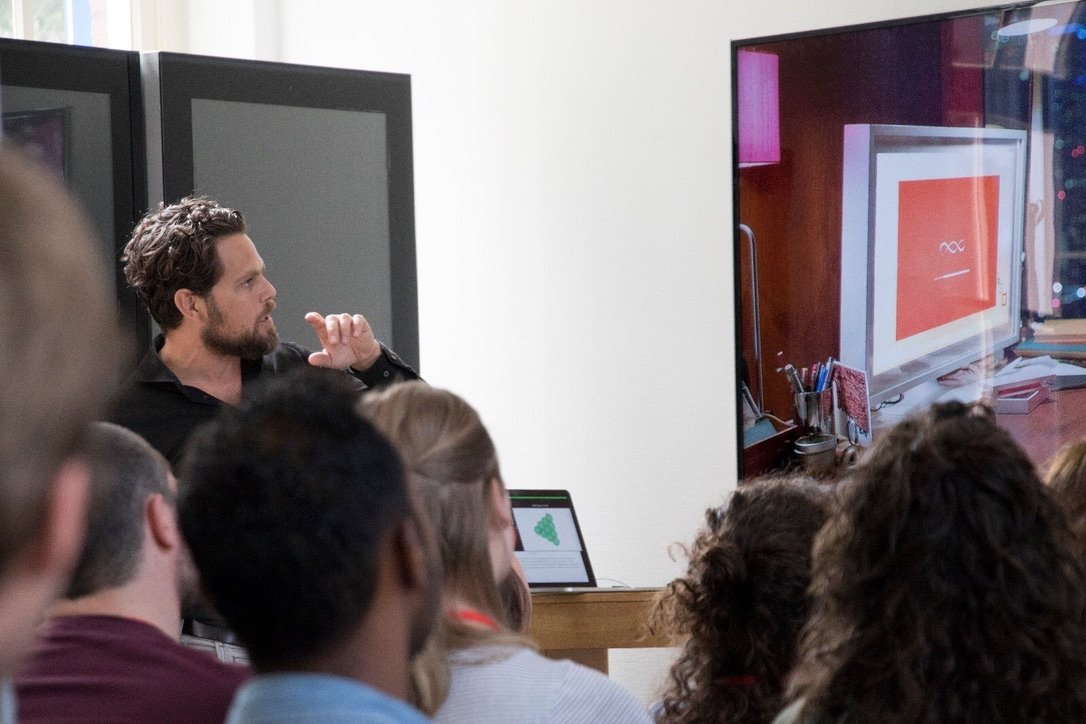 UXcamp Amsterdam 2018 IJsfontein Amsterdam – June 9, 2018
Dare to be different.
Pixel perfect design is an illusion, and good tools alone do not make a good designer. This barcamp session was about the secret skills an effective designer needs, told as five superpowers. Ultra-mega-vision: understand the context, from who the user is and what they want to do, to the touchpoints before, during and after, and everything that can be measured, like time, location, speed or weather. Atomic brain-power: think from a business perspective, from vision and strategic pillars to KPIs, and an experience map that links user needs, business goals and channels. Amorphic flexibility: accept that a design is impermanent, incomplete and imperfect, and leave room to grow. Work like a scientist: do research, run workshops with clients and test what you create. And break the boundaries: dare to be different, because branding is about accentuating differences.
Being different
Fontys, University of applied sciences Tilburg Tilburg – April 24, 2018Branding is about accentuating differences.
The focus of design is shifting from craftsmanship to copying best practices, and that is a problem. Physical products show how much room there is to be different, while many websites follow the same trends and start to look alike. Dieter Rams made Braun, but there is only one Braun: we have to be somebody else, and find our own place between minimal and expressive, conservative and innovative. Craft is hard and takes both breadth and depth, down to an 8-point grid. Craft gives you good design, creativity on top makes it standout design, and perseverance gets you there. So work together, argue your choices, test, think outside the box and stay in shape.
Craftmanship
 Dutch Design Week Breakfast session Eindhoven – October 27, 2017
In this field of work you have to specialize.
Design Thinking by Doing
IXDC 2017 workshop: The Wallet Project Beijing – July 13, 2017Understand the problem before you design the solution.
A three-hour workshop at IXDC, the biggest UX conference in Asia, given together with Lexi Lin of Mirabeau. Large companies tend to jump from a problem straight to a solution. Design thinking first takes the time to understand the problem, and that starts with empathy: seeing how someone’s behaviour is shaped by their physical, inner, symbolic, relational, situational and cultural context. In the Wallet Project, participants first drew the “ideal” wallet on their own. Then they paired up and designed a wallet for their partner instead, going through a full design cycle: interview and dig deeper (empathize), capture insights and take a point of view (define), sketch radical ideas and get feedback (ideate), build it with their hands (prototype) and share it for feedback (test). Each team ended by pitching their prototype, which showed how much observing, prototyping and adjusting to someone’s context changes the result.
Lost in translation
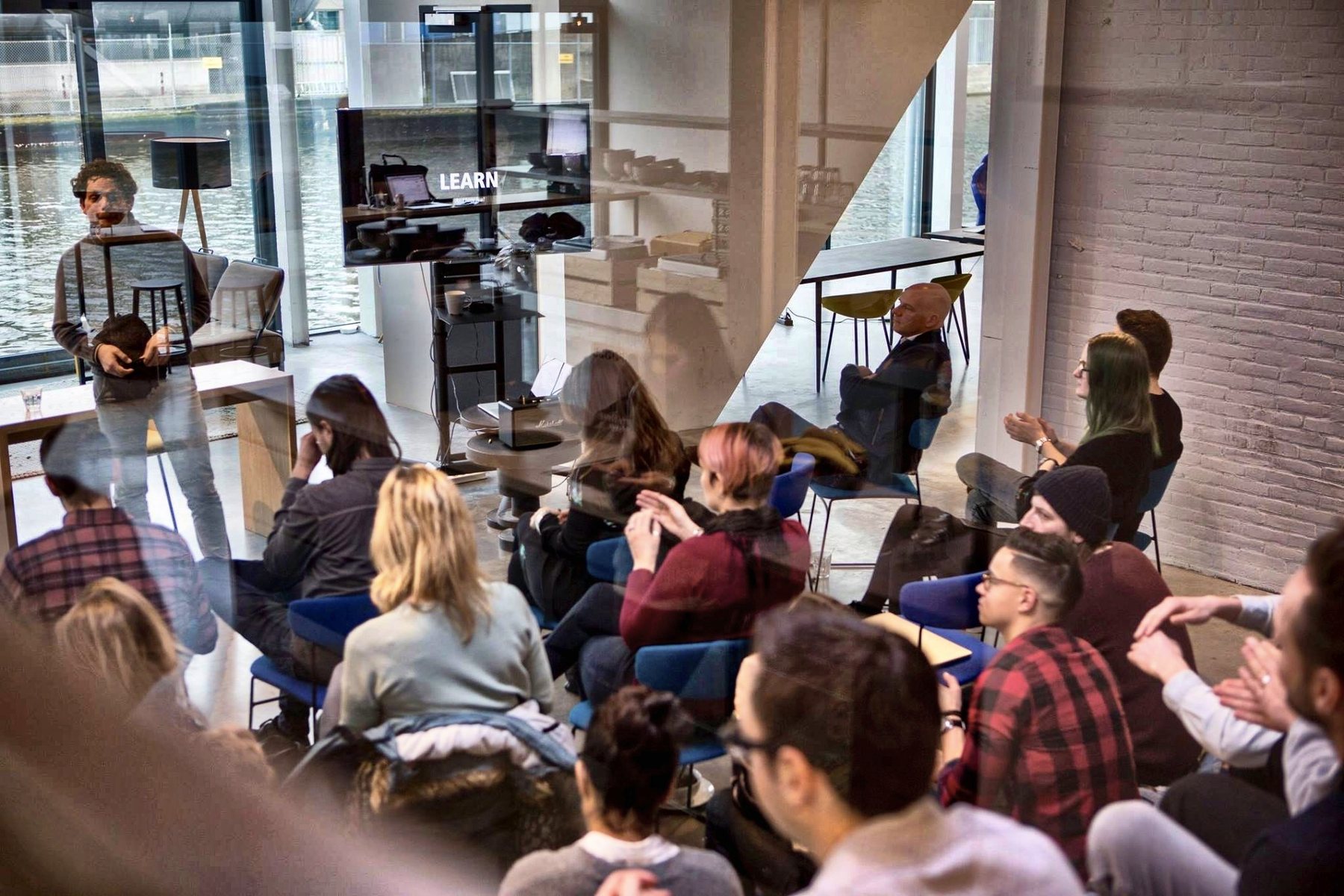 Dutch Digital Agencies – UX Meet-up: The English Breakfast Edition Amsterdam – February 28, 2017
Show, don’t just tell.
Together with China Southern Airlines, Mirabeau worked on a new app around services, sales and loyalty: a first project for an Asian client. A user-centred approach was the starting point, but it was not obvious that it would work in China. This talk shares what we ran into and what we learned. Culture shows up everywhere, from dragons and zodiac signs to colours and traditions. Everything is mobile: responsive matters less, apps like WeChat are everything, QR codes are hot and promotions are big. The local design and development scene is mature, so the bar is high. The hotel became our office, and we brought research, personas and scrum into the process. What worked best: show instead of explain, with demos and local examples; design with real content written by a native speaker; test more than once to convince stakeholders; and make sure you talk to the right person. And have fun while you learn.
Unleash the Artificial Smartness
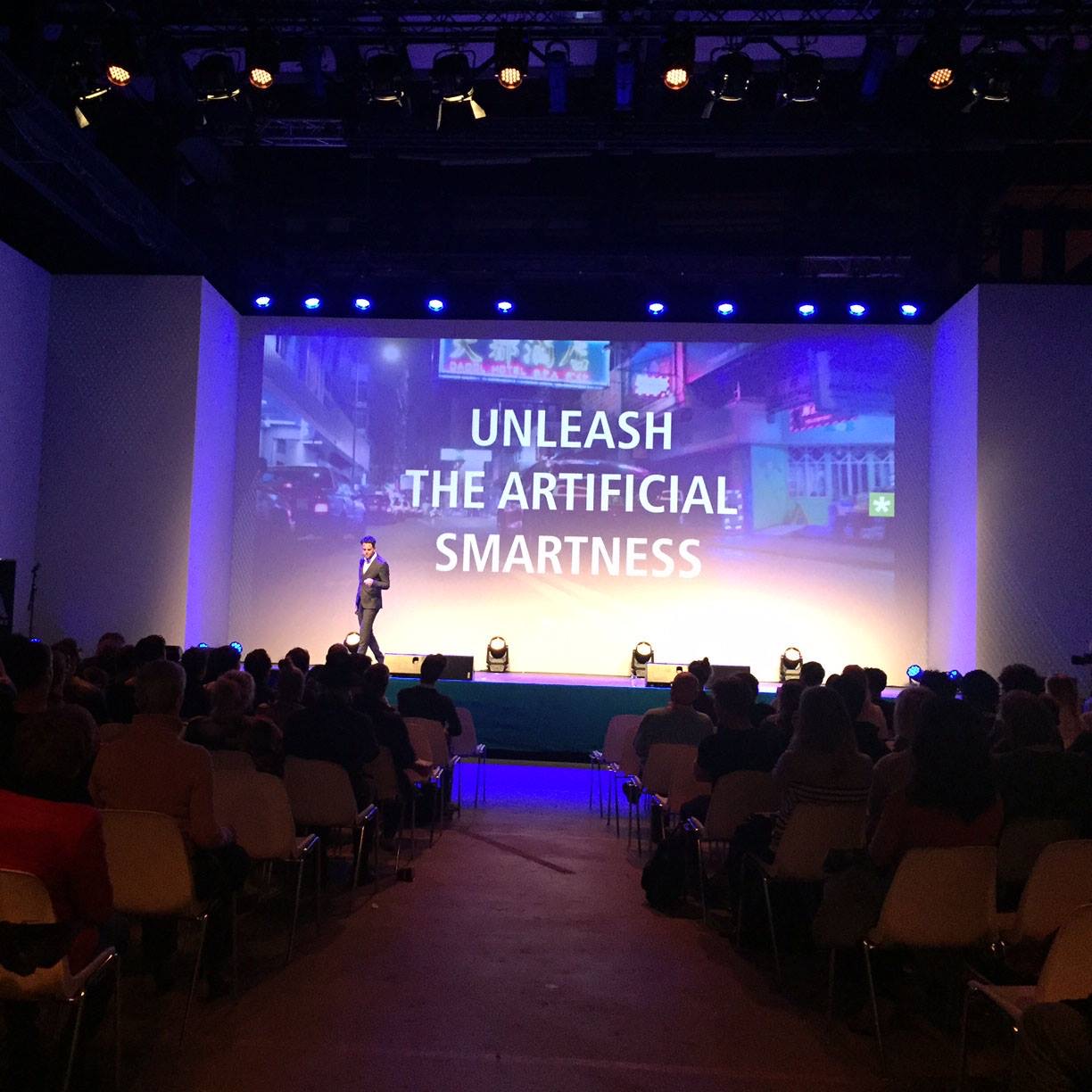 Dutch Design Week goes Digital: Where Digital Meets the Real World Klokgebouw Eindhoven – October 28, 2016
Design artificial smartness, not artificial intelligence.
The trend is to take a digital service and add AI. Everything becomes connected and “intelligent”, and people end up overwhelmed. When a Tesla drives into a Tesla sign, that is not the driver’s mistake but the designer’s: the car never learned the sign was there. Intelligence aims at a machine that thinks for itself. Smartness is focused, measurable and specific: it tells people more about the world so they can act better themselves. Starting from Don Norman’s questions of how we do, feel and know, this talk shows how layers of context (where you are, what you did, what you chose and who you are) add up to artificial smartness. Not a self-driving car, but a car that gives smart suggestions and works with its driver like a horse with its jockey.
Dynamic Design
Sitecore Wintercamp Webinar – January 20, 2015De wereld van print is oneindig veel dynamischer dan de wereld van web. Denk aan de spectaculaire wisselingen van covers van magazines en kranten. Veel websites zijn daarentegen nogal statisch: het design schikt zich vaak keurig naar de beschikbare schermresolutie van het device. Klanten verwachten online ervaringen die reageren op échte gebruikersvariabelen als locatie, tijd en het aantal keren en de wijze waarop de toepassing wordt gebruikt. Paul Versteeg laat tijdens zijn webinar ‘Dynamic Des
Dynamic Design
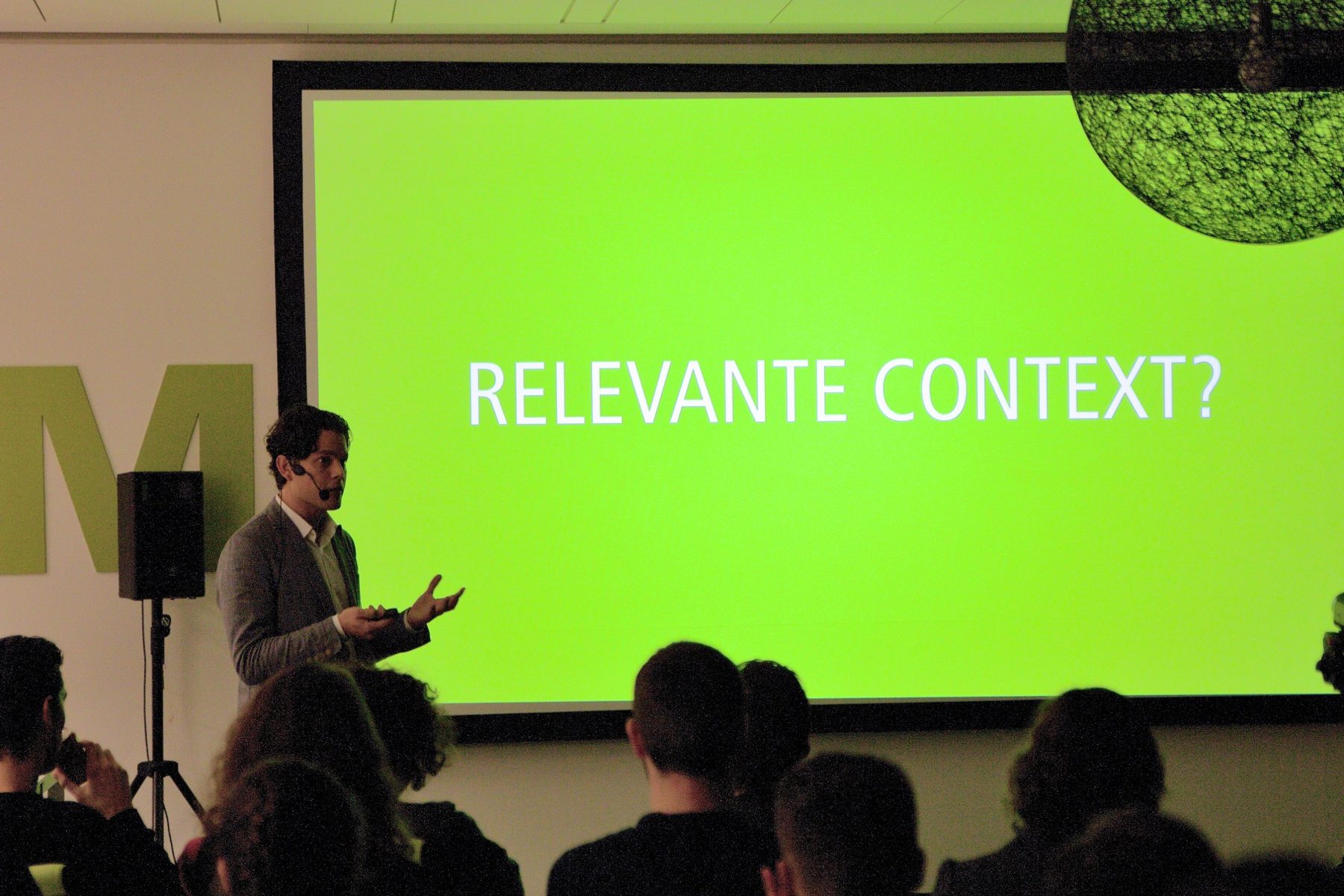 UX Cocktail Hour Rotterdam #15 Mirabeau Rotterdam – November 25, 2014
Design for user goals, not business features.
Dynamic design is the design of a context-dependent interface. Devices used to be the starting point; now user needs lead. Almost anything we can measure can be context: time, location, weather, speed, earlier use, whether someone is logged in, even the light around the screen. That gives designers a lot of power, but data only adds value when it makes the experience personal and relevant. And since nothing we build lasts much longer than two years, a design is never finished: leave room to grow and value adaptability over beauty, like a campus that lets people walk their own paths before laying the pavement. The talk showed our dynamic design workflow, from strategy and scope to structure, surface and ongoing optimization. In the design thinking workshop that followed, groups picked the single most important user goal, defined who has that goal, mapped their journey and looked for the moments where context could enrich the experience.
Defining Interaction
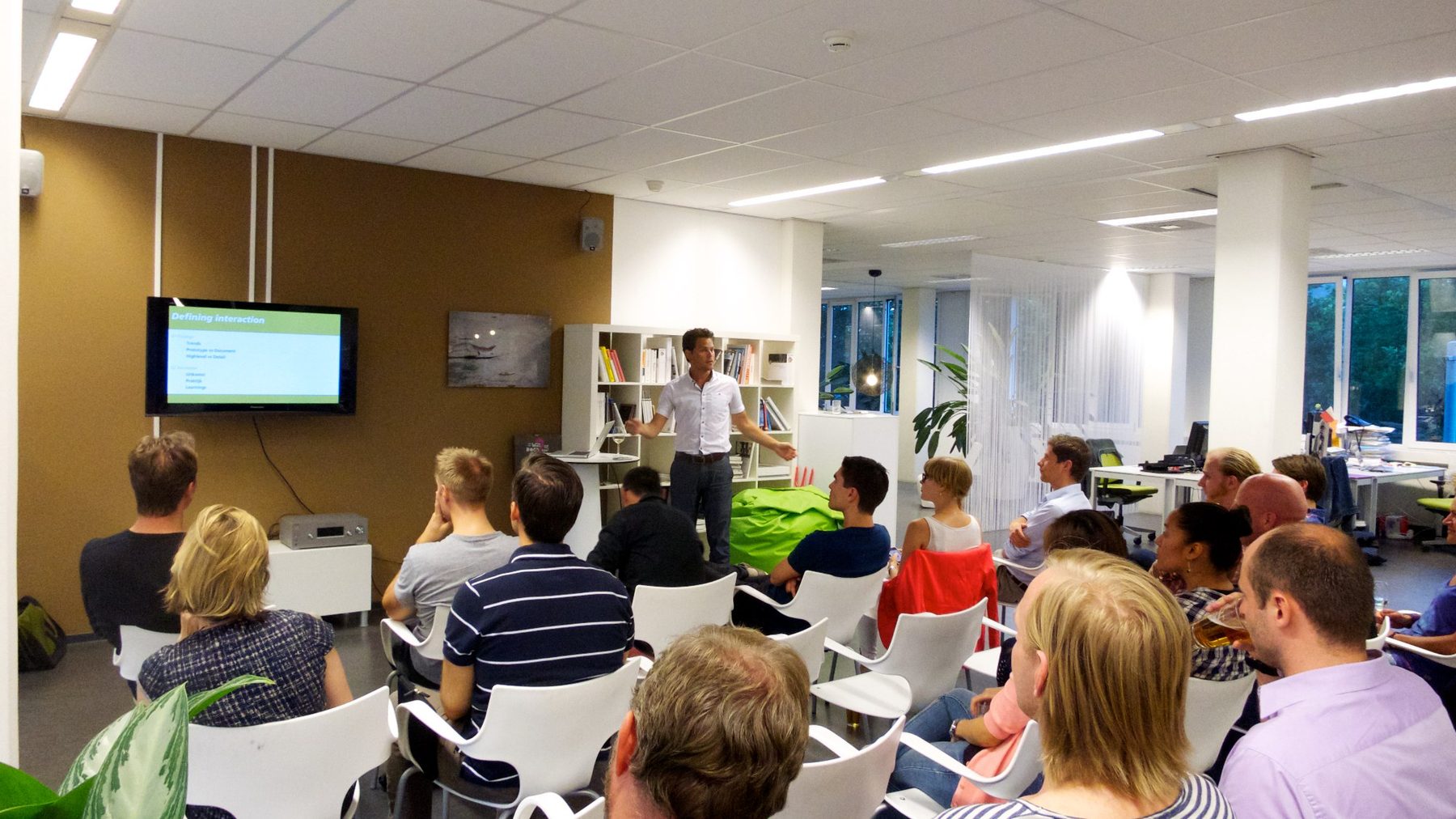 UX Cocktail Hour Amsterdam; Hot Summer Night at Mirabeau Mirabeau Amsterdam – September 4, 2012
An interaction design is a means, not the goal.
New trends like responsive design, motion, parallax scrolling and one-page sites are hard to capture on paper, and teams increasingly work agile, side by side with the client. Prototypes tell a good story but take a lot of time and quickly go out of date; detailed documents record every agreement but are hardly read. This talk shared the first findings of a different approach: stay high-level and define the rest by trying. Start from the requirements, sketch the concept on big A3 sheets and present the key parts to the client: business goals, user scenarios, flows, a content index and wireframes. Then add detail in iterations, together with visual design and front-end development, who take the lead from there. Like a good cocktail: the interaction designer brings the right ingredients (function, content and its hierarchy) and leaves the tools and the taste to the people who master them.